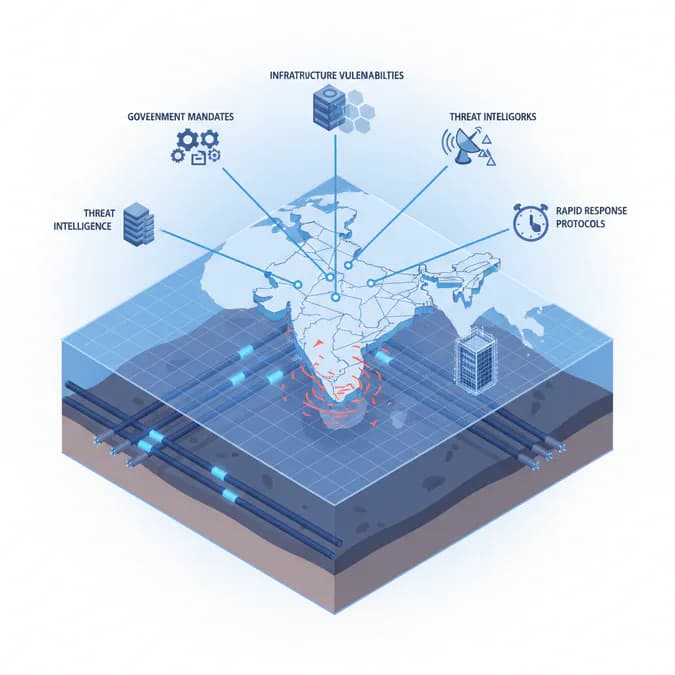
India's digital economy faces an unprecedented infrastructure challenge as escalating tensions in West Asia threaten the subsea cable risks India must now address. The Indian Department of Telecommunications (DoT) has issued urgent directives to telecom firms and subsea cable operators to assess vulnerabilities and develop fallback options, recognizing that these underwater fiber-optic pipelines represent critical national infrastructure. Understanding subsea cable risks India faces is essential for maintaining the nation's connectivity and economic growth.
Subsea cables carry over 95% of international internet traffic globally, making them essential to India's ambitions to become a $270 billion data hub. However, the current geopolitical situation in West Asia, including Iran's explicit threats to undersea infrastructure and ongoing conflicts in the Red Sea and Strait of Hormuz, has exposed dangerous vulnerabilities in India's connectivity architecture. This is no longer a hypothetical risk—it's an immediate operational concern for the telecom industry.
The situation has intensified following recent cable damage incidents. In February 2024, the AAE-1, SEACOM, and EIG cables were damaged in the Red Sea, disrupting connectivity across Asia and Africa and affecting up to 25% of regional traffic. More recently, in September 2025, the SMW4 and IMEWE cables were severed near Jeddah, causing internet slowdowns across India, Pakistan, and the UAE. These incidents demonstrate that the threat is not merely theoretical—it's already manifesting in real-world disruptions.
India's vulnerability is particularly acute because approximately one-third of the nation's westbound internet traffic depends on networks linked to the Strait of Hormuz, a critical chokepoint in global maritime commerce. With major cable landing stations concentrated in Mumbai and Chennai, India's connectivity infrastructure presents a concentrated risk profile that demands immediate attention and strategic diversification.
Government Directive and Risk Assessment for Subsea Cable Risks India
The Indian government's response to these escalating threats has been decisive and comprehensive. The Department of Telecommunications has mandated that all telecom operators and subsea cable operators conduct thorough risk assessments of their critical data pipelines. This directive represents a significant shift in how India approaches infrastructur

The assessment requirements include detailed mapping of cable routes, identification of vulnerable segments, and evaluation of exposure to geopolitical risks. Telecom firms are being asked to provide specific data on which cables serve critical functions, what percentage of traffic flows through each route, and what the consequences would be if specific cables were damaged or severed.
Beyond assessment, the government is explicitly asking operators to develop contingency plans and fallback options. These aren't theoretical exercises—they're operational requirements that must be implemented and tested. The directive acknowledges that while 70% of global cable faults are caused by accidents like fishing vessel damage or anchor strikes, the current geopolitical environment introduces intentional sabotage as a realistic threat vector.
According to TelecomTalk's analysis, the DoT's contingency planning requirements are forcing operators to rethink their entire approach to infrastructure redundancy and risk management. This represents one of the most significant shifts in Indian telecom infrastructure policy in recent years.
Subsea Cable Infrastructure Vulnerability in India
India's subsea cable infrastructure, while extensive, faces several critical vulnerabilities that the current geopolitical situation has brought into sharp focus. The nation's internet connectivity depends on a network of fiber-optic cables laid on ocean floors, connecting India to Europe, Asia, Africa, and beyond. However, this infrastructure was designed with assumptions about stable geopolitical conditions that no longer hold.
Geographic Concentration and Chokepoints
The concentration of westbound traffic through the Strait of Hormuz represents a critical chokepoint. When cables in this region are damaged, the impact ripples across India's entire digital economy. The 2024 Red Sea incidents demonstrated this vulnerability clearly—25% of regional traffic between Asia, Europe, and Africa was disrupted, affecting everything from financial transactions to cloud services to international trade operations.
This geographic concentration creates what security analysts call a "single point of failure" scenario. Multiple cables may be routed through the same geographic corridor, meaning a single incident can damage multiple cables simultaneously. The September 2025 incident near Jeddah, which damaged both SMW4 and IMEWE cables, exemplifies this risk.
Repair and Recovery Challenges
India currently lacks domestic cable repair ships, a significant operational vulnerability. When cables are damaged, the nation must rely on foreign contractors to conduct repairs, a process that can take weeks or months. This dependency creates extended periods of reduced capacity and increased latency, with cascading effects across the digital economy.
The absence of domestic repair capability means that India's recovery from cable incidents is entirely dependent on the availability and prioritization of international repair vessels. During periods of high global cable damage, India may face extended queues for repair services, prolonging service disruptions.
Traffic Concentration and Capacity Risks
The infrastructure also faces vulnerability from the sheer concentration of cables in specific geographic areas. While this concentration made economic sense historically, it creates risk concentration that geopolitical events can exploit. A single incident in a high-traffic corridor can disrupt service for millions of users and impact critical business operations.
West Asia Tensions and Threat Landscape
The threat landscape in West Asia has evolved significantly since late February 2026, creating unprecedented risks for subsea infrastructure. Iran has made explicit threats targeting undersea cables, viewing them as legitimate targets in the context of broader regional conflicts. These aren't vague warnings—they represent stated intentions that telecom operators must take seriously.
According to Sahi's analysis, "This is no longer a hypothetical risk." The explicit nature of threats to subsea infrastructure has elevated the urgency of contingency planning across the Indian telecom industry.
Active Conflict Zones and Cable Exposure
The Red Sea and Strait of Hormuz have become active conflict zones with direct implications for subsea cable infrastructure. The 2024 cable cuts in the Red Sea and the 2025 incidents near Jeddah demonstrate that these threats are not hypothetical. Cables in these regions face risks from military activities, accidental damage during conflicts, and deliberate sabotage.
The geopolitical situation creates a complex risk environment where traditional risk assessment models may prove inadequate. Cables that were previously considered low-risk based on historical data now face elevated threat levels due to changed circumstances. This requires operators to adopt more dynamic risk assessment approaches that account for rapidly evolving geopolitical conditions.
Impact on Global and Regional Connectivity
The conflicts in West Asia have broader implications beyond India. According to Whalesbook's reporting, India's $270 billion data hub ambitions are directly threatened by subsea cable risks. The nation's ability to serve as a regional data hub depends on reliable connectivity to global markets, which is now at risk.
Contingency Planning and Fallback Options
Telecom operators are now developing comprehensive contingency plans to address subsea cable risks India faces. These plans go beyond simple backup systems—they represent fundamental rethinking of how India's internet infrastructure should be architected to withstand geopolitical disruptions.
Alternative Routing and Geographic Diversification
Fallback options include developing alternative routing paths that bypass vulnerable corridors. Rather than routing all westbound traffic through the Strait of Hormuz region, operators are exploring routes that distribute traffic across multiple geographic paths. This diversification reduces the impact of any single cable failure and makes the overall network more resilient.
Projects like Google's Blue-Raman cable initiative and Meta's 2Africa system represent attempts to create alternative connectivity pathways. However, Meta has recently paused work on the 2Africa system due to security concerns in the Persian Gulf, Pakistan, and India sections, highlighting how geopolitical risks are directly impacting infrastructure development timelines.
Capacity Management During Disruptions
Contingency plans also address capacity management during disruptions. If primary cables are damaged, operators must have procedures to shift traffic to alternative routes, manage congestion, and maintain service quality for critical applications. This requires significant investment in network management systems and redundant capacity.
These procedures must be tested regularly to ensure they function effectively during actual emergencies. Operators are conducting tabletop exercises and simulations to identify gaps in their contingency planning and refine their response procedures.
Traffic Engineering and Load Balancing
Advanced traffic engineering techniques are being deployed to optimize the use of alternative routes during disruptions. Rather than simply shifting all traffic to backup cables, sophisticated load balancing algorithms distribute traffic across available capacity to minimize congestion and maintain service quality.
Impact on Indian Telecom Services
The subsea cable risks India faces have direct implications for Indian telecom services and the broader digital economy. Internet slowdowns resulting from cable damage affect everything from basic browsing to cloud services to financial transactions. For a nation aspiring to become a $270 billion data hub, these disruptions represent significant economic costs.
Service Quality and User Experience
The 2024 and 2025 cable incidents already demonstrated these impacts. When cables are damaged, users experience increased latency, reduced bandwidth, and service interruptions. For businesses relying on cloud services, international payments, or real-time data processing, these disruptions translate directly into lost productivity and revenue.
The impact extends beyond individual users to entire business sectors. Financial services, e-commerce, software development, and business process outsourcing—all critical to India's digital economy—depend on reliable international connectivity. Cable disruptions create cascading failures across these sectors.
Business Continuity and Economic Impact
The telecom industry itself faces pressure to maintain service quality despite infrastructure vulnerabilities. Customers expect reliable connectivity regardless of geopolitical circumstances, creating tension between operational realities and service expectations. Telecom operators must invest heavily in redundancy and alternative routing to meet these expectations.
The economic impact of cable disruptions extends beyond immediate service interruptions. Businesses may relocate operations to regions with more reliable connectivity, and India's attractiveness as a data hub location may be diminished if connectivity reliability cannot be guaranteed.
Industry Response and Compliance
India's major telecom operators are actively responding to government directives and developing comprehensive risk mitigation strategies. These responses go beyond compliance—they represent strategic investments in infrastructure resilience.
Tata Communications' Infrastructure Assessment
Tata Communications, as a major subsea cable operator, is conducting detailed assessments of its cable portfolio and developing contingency plans for critical routes. The company is evaluating which cables serve essential functions and what alternative routing options exist for traffic currently dependent on vulnerable cables.
Tata Communications operates multiple subsea cable systems connecting India to global markets. The company's assessment process includes detailed analysis of each cable's geographic route, traffic volume, and vulnerability to geopolitical risks. This assessment informs investment decisions about new cable systems and alternative routing capabilities.
Bharti Airtel's Risk Mitigation Strategy
Bharti Airtel and other telecom operators are similarly engaged in risk assessment and contingency planning. These efforts include detailed mapping of their traffic flows, identification of vulnerable segments, and development of procedures to manage disruptions when they occur.
Bharti Airtel's response includes investment in redundant international connectivity and development of procedures to shift traffic to alternative routes during disruptions. The company is also engaging with government agencies to ensure its contingency plans align with national security requirements.
Competitive Differentiation Through Resilience
Compliance with government directives is becoming a competitive differentiator in the Indian telecom market. Operators that can demonstrate robust contingency planning and infrastructure resilience gain competitive advantages in customer confidence and regulatory standing. This is driving significant investment in redundancy and alternative routing capabilities.
Telecom operators are increasingly marketing their infrastructure resilience as a competitive advantage. Customers seeking reliable international connectivity are willing to pay premiums for operators that can guarantee service continuity during geopolitical disruptions.
Long-term Infrastructure Resilience Strategies
Beyond immediate contingency planning, the Indian telecom industry is developing long-term strategies to build more resilient infrastructure. These strategies recognize that geopolitical risks are likely to persist and that infrastructure must be designed to withstand them.
Geographic Diversification of Cable Routes
One key strategy involves geographic diversification of cable routes. Rather than concentrating traffic through specific corridors, operators are exploring multiple pathways that distribute risk across different geographic regions. This requires investment in new cable systems and landing stations, but creates more resilient overall architecture.
New cable systems are being planned to route traffic through alternative geographic corridors. Rather than relying exclusively on routes through the Strait of Hormuz, operators are developing routes through the Indian Ocean and alternative pathways to Europe and Asia.
Domestic Cable Repair Capability Development
Another strategy involves developing domestic cable repair capabilities. India's current dependence on foreign contractors for cable repairs creates unacceptable delays during emergencies. Building domestic repair capacity would reduce response times and increase operational independence.
This strategy requires significant investment in specialized vessels, equipment, and trained personnel. However, the strategic benefits of reduced repair times and operational independence justify the investment. Several Indian companies are exploring opportunities to develop cable repair capabilities.
Redundant Capacity Investment
Investment in redundant capacity represents another critical strategy. If cables are damaged, alternative routes must have sufficient capacity to handle diverted traffic without creating service degradation. This requires building excess capacity into the network, an expensive proposition but necessary for resilience.
Operators are investing in additional cable systems and increasing the capacity of existing routes to ensure that alternative pathways can handle traffic diverted from damaged cables. This redundancy increases costs but provides essential resilience.
Diplomatic and International Engagement
Diplomatic efforts also play a role in long-term resilience strategies. Engaging with regional actors to reduce threats to subsea infrastructure and establishing international norms protecting critical undersea infrastructure are important components of a comprehensive approach to resilience.
India is working with international partners to establish norms protecting subsea cable infrastructure from deliberate damage. These diplomatic efforts aim to reduce the likelihood of intentional cable sabotage and establish international agreements protecting critical infrastructure.
Frequently Asked Questions About Subsea Cable Risks India
What percentage of India's internet traffic depends on subsea cables?
Subsea cables carry over 95% of international internet traffic globally. For India specifically, approximately one-third of the nation's westbound internet traffic depends on networks linked to the Strait of Hormuz, making this region critically important for India's connectivity.
What recent cable damage incidents have affected India?
In February 2024, the AAE-1, SEACOM, and EIG cables were damaged in the Red Sea, affecting up to 25% of regional traffic. More recently, in September 2025, the SMW4 and IMEWE cables were severed near Jeddah, causing internet slowdowns across India, Pakistan, and the UAE.
What is the government's response to subsea cable risks India faces?
The Indian Department of Telecommunications has issued directives requiring all telecom operators and subsea cable operators to conduct thorough risk assessments, develop contingency plans, and identify fallback options for critical data pipelines. These requirements treat subsea cable risks as a matter of national security.
How long does it take to repair damaged subsea cables?
Cable repair can take weeks or months, depending on the location and severity of damage. India's lack of domestic cable repair ships means the nation must rely on foreign contractors, extending repair timelines and creating extended periods of reduced capacity.
What alternative routing strategies are operators implementing?
Telecom operators are developing alternative routing paths that bypass vulnerable corridors, diversifying traffic across multiple geographic pathways. Projects like Google's Blue-Raman cable and Meta's 2Africa system represent attempts to create alternative connectivity routes, though some have been paused due to security concerns.
How do subsea cable disruptions impact India's data hub ambitions?
India's goal to become a $270 billion data hub depends on reliable international connectivity. Subsea cable disruptions threaten this ambition by reducing service reliability and potentially causing businesses to relocate operations to regions with more stable connectivity.
The Bottom Line
India's subsea cable risks represent unprecedented challenges that demand immediate and sustained attention. The government's response through mandatory risk assessments and contingency planning represents appropriate recognition of these threats. The telecom industry is responding with significant investments in redundancy, alternative routing, and contingency planning to address subsea cable risks India faces.
However, these responses are only the beginning. Long-term resilience requires sustained investment in infrastructure diversification, domestic repair capabilities, and diplomatic efforts to protect critical undersea infrastructure. For a nation aspiring to become a global data hub, ensuring reliable and resilient connectivity is not optional—it's fundamental to economic competitiveness and national security.
The coming months will be critical as telecom operators implement their contingency plans and the government monitors compliance with risk assessment directives. The success of these efforts will determine whether India can maintain its digital growth trajectory despite geopolitical challenges in West Asia.
Sources
- Automated Pipeline
- DoT Seeks Contingency Plans From Telcos Over Subsea Cable Risks
- Can the Middle East War Slow India's Internet? Explained
- India's $270B Data Hub Goal Threatened by Subsea Cable Risks
- Govt Asks Telcos To Assess Subsea Cable Risks
- Why the West Asia war is also an internet crisis, not just an energy one
- Source: economictimes.com
- Source: m.thewire.in
- Source: cescube.com
- Source: firstpost.com
- Source: globalsouthforum.org