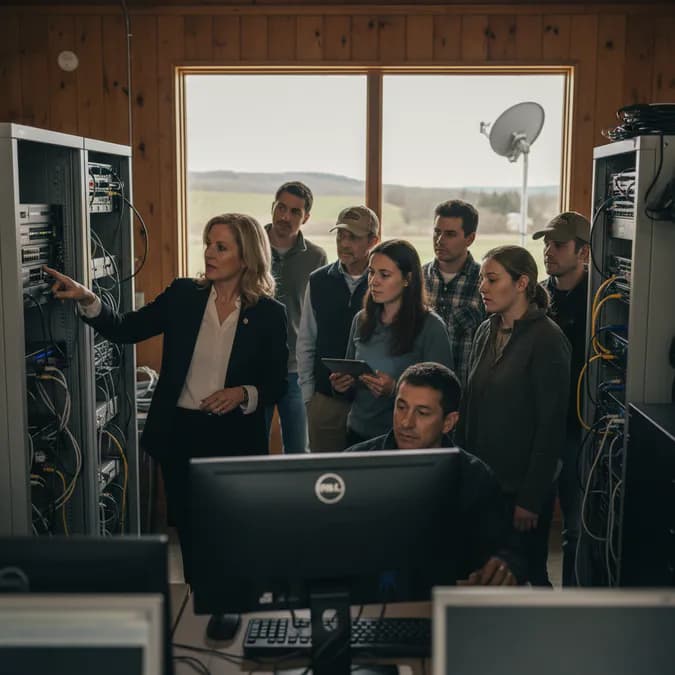
Senator Kirsten Gillibrand is leading a bipartisan push to secure $350 million in rural broadband funding for the USDA's Rural Broadband Access Grant, Loan and Loan Guarantee Program as part of FY2025 appropriations. This initiative represents a critical effort to expand broadband infrastructure in rural communities across the country, where private investment remains insufficient due to high deployment costs and low customer density. The funding request underscores the ongoing challenge of bridging America's digital divide and ensuring rural Americans have equitable access to broadband services.
The Rural Broadband Crisis: Understanding the Digital Divide
Rural America continues to face a significant connectivity gap that affects economic development, education, healthcare, and quality of life. While urban and suburban areas have seen rapid broadband deployment, rural communities often lack access to reliable high-speed internet. This digital divide has become increasingly problematic as broadband access is now essential for pa

The challenge stems from fundamental economics: broadband infrastructure is expensive to build, and rural areas have lower population densities, making it difficult for private companies to justify investment. The USDA Rural Broadband Access Grant, Loan and Loan Guarantee Program addresses this market failure by providing financial support for middle-mile and last-mile infrastructure development in areas where private investment is insufficient. This program recognizes that rural broadband requires different approaches and financial mechanisms than urban expansion.
Gillibrand's FY2025 Funding Request: $350 Million for USDA Program
Senator Kirsten Gillibrand is calling for $350 million in rural broadband funding for the USDA's Rural Broadband Access Grant, Loan and Loan Guarantee Program in FY2025 appropriations. This request seeks to fund the program at its fully authorized annual level, ensuring consistent support for rural broadband deployment initiatives across the country.
The $350 million request is part of a broader bipartisan effort to prioritize rural connectivity. As Gillibrand stated, "In order to close the pervasive digital divide Congress must do our job for rural Americans." [WAMC] This sentiment reflects growing recognition across both political parties that federal investment is essential to ensure rural communities are not left behind in the digital economy.
The timing of this request is significant. It comes as Congress works on FY2025 appropriations bills and builds on momentum from previous federal broadband initiatives. The Infrastructure Investment and Jobs Act, also known as the Bipartisan Infrastructure Law, authorized $1.9 billion in supplemental funding over 10 years for the USDA's ReConnect program, demonstrating substantial federal commitment to rural broadband expansion.
How the USDA Rural Broadband Access Program Works
The USDA Rural Broadband Access Grant, Loan and Loan Guarantee Program, often associated with the ReConnect initiative, operates by providing three types of financial support to broadband providers and rural communities:
- Grants: Direct funding that does not require repayment, helping providers offset the high upfront costs of infrastructure deployment in rural areas.
- Loans: Favorable financing terms that allow providers to borrow capital for broadband projects at rates better than commercial alternatives.
- Loan Guarantees: Federal backing that reduces lender risk, making it easier for providers to secure private financing for rural broadband projects.
These financial mechanisms enable broadband providers to build both middle-mile infrastructure (the backbone networks that connect communities) and last-mile infrastructure (the final connections to homes and businesses). The program supports connectivity for farms, small towns, and rural communities, with the ultimate goal of improving access to telehealth, education, remote work opportunities, and agricultural modernization.
The program is particularly valuable because it recognizes that rural broadband deployment requires different approaches than urban expansion. Rural projects often involve longer distances, more challenging terrain, and smaller customer bases, all of which increase per-unit costs. Federal support helps bridge this economic gap and enables providers to undertake projects that would otherwise be economically unfeasible.
Bipartisan Support and Political Momentum
Gillibrand's push for $350 million in FY2025 funding reflects bipartisan recognition of rural broadband's importance. The effort involves coordination with colleagues from both parties who understand that rural connectivity transcends partisan politics. Rural broadband affects farmers, small business owners, students, and healthcare access across all states and political affiliations.
This bipartisan approach has proven effective in previous funding cycles. The Bipartisan Infrastructure Law itself demonstrated that rural broadband can unite Democrats and Republicans around a common goal. The $1.9 billion in supplemental ReConnect funding authorized through that legislation shows that when rural broadband is framed as essential infrastructure, it gains broad political support.
The bipartisan letter urging appropriators to fully fund the USDA rural broadband program at the authorized annual level represents ongoing commitment to this issue. Senators recognize that underfunding the program would leave rural communities behind and undermine the broader federal broadband expansion strategy. This sustained bipartisan effort increases the likelihood that adequate funding will be secured in the appropriations process.
Real-World Impact: New York's Broadband Success Story
New York provides a compelling example of how federal broadband funding translates into real-world infrastructure deployment. Senator Gillibrand has been instrumental in securing substantial federal broadband allocations for her state, demonstrating the tangible benefits of federal investment.
In a major announcement, New York received more than $664 million in federal funding for broadband expansion through the Bipartisan Infrastructure Law's BEAD (Broadband Equity, Access and Deployment) program. Gillibrand stated, "This $664+ million in funding will bring broadband to communities across New York that have lacked access for years, spur economic growth, and improve quality of life for New York families."
Beyond the BEAD allocation, New York announced an additional $140 million in public broadband infrastructure funding through state and federal programs. These investments are expected to result in over 1,200 miles of new public broadband infrastructure being built across the state, connecting homes and businesses in previously underserved areas.
These New York examples illustrate how federal programs like the USDA Rural Broadband Access Grant translate into concrete infrastructure deployment. When properly funded, these programs enable states to build the broadband networks that rural communities desperately need. The combination of grants, loans, and loan guarantees creates a comprehensive financing approach that addresses the unique challenges of rural broadband expansion.
Challenges Ahead: Obstacles to Rural Broadband Expansion
Despite progress, significant challenges remain in expanding rural broadband access. Understanding these obstacles is essential for appreciating why sustained federal funding is necessary.
Economic Barriers
Rural broadband projects remain expensive relative to the customer base they serve. Even with federal support, providers must navigate complex financing and project management. Ensuring adequate annual funding prevents gaps in deployment momentum and allows providers to plan multi-year projects with confidence.
Technological Diversity
Rural areas require different broadband technologies depending on geography and existing infrastructure. Some areas need fiber-optic deployment, others benefit from wireless solutions, and some require hybrid approaches. This diversity increases complexity and cost, requiring flexible funding mechanisms that can support various deployment strategies.
Competitive Dynamics
In some rural areas, incumbent providers have little incentive to upgrade infrastructure. Federal programs must encourage competition and investment without disrupting existing service providers. Balancing these considerations requires careful program design and oversight.
Planning and Coordination
Successful rural broadband expansion requires coordination between federal agencies, state governments, local communities, and private providers. Bureaucratic processes can slow deployment, and ensuring efficient program administration is critical to maximizing the impact of federal funding.
Sustainability
Building broadband infrastructure is only the first step. Ensuring long-term sustainability requires adequate operating budgets and business models that work in low-density areas. Federal funding must support not just construction but also ongoing operations and maintenance.
The Path Forward: What This Funding Could Achieve
If Congress approves the $350 million in FY2025 funding for the USDA Rural Broadband Access Grant, Loan and Loan Guarantee Program, the impact could be substantial. This level of consistent annual funding would enable:
Accelerated Infrastructure Deployment
Providers could plan multi-year projects with confidence, accelerating the pace of rural broadband buildout. Predictable annual funding allows for better project planning and resource allocation, reducing inefficiencies and delays.
Expanded Geographic Coverage
More rural communities could access funding, ensuring that broadband expansion reaches underserved areas across the country. With adequate resources, the program can support projects in multiple states simultaneously, creating a nationwide network of rural broadband initiatives.
Economic Development
Broadband access enables rural businesses to compete globally, attracts remote workers to rural areas, and supports agricultural modernization. Rural entrepreneurs can access online markets, and farmers can adopt precision agriculture technologies that increase productivity and sustainability.
Educational Equity
Students in rural areas would have reliable broadband for online learning, closing educational gaps between rural and urban students. Distance learning becomes viable, and students can access educational resources and opportunities previously unavailable in their communities.
Healthcare Access
Telehealth services become viable in rural communities with adequate broadband, improving healthcare access and reducing the need for travel to distant medical facilities. Rural residents can consult with specialists remotely and access preventive care services more easily.
Agricultural Innovation
Modern farming increasingly relies on data analytics, precision agriculture, and remote monitoring. Broadband access enables farmers to adopt these technologies, improving yields, reducing environmental impact, and enhancing competitiveness in global markets.
The $350 million request represents a commitment to sustained federal investment in rural broadband. While it may seem substantial, it reflects the scale of the challenge: rural America spans vast geographic areas with dispersed populations, and closing the digital divide requires sustained, adequate funding.
Closing America's Digital Divide
Senator Kirsten Gillibrand's push for $350 million in FY2025 federal funding for the USDA Rural Broadband Access Grant, Loan and Loan Guarantee Program represents a critical step toward closing America's digital divide. The bipartisan nature of this effort underscores that rural broadband is not a partisan issue but a fundamental infrastructure need.
The evidence from New York and other states shows that when federal funding is available, rural broadband deployment accelerates. Communities gain access to services and opportunities that were previously unavailable. Businesses can compete, students can learn, and healthcare becomes more accessible.
As Congress works on FY2025 appropriations, the decision to fully fund this program at the authorized $350 million level will signal commitment to rural America. Underfunding would slow deployment and leave communities behind. Full funding would demonstrate that Congress recognizes rural broadband as essential infrastructure worthy of sustained federal investment.
The digital divide remains one of America's most pressing infrastructure challenges. Federal programs like the USDA Rural Broadband Access Grant, Loan and Loan Guarantee Program provide proven mechanisms for addressing this challenge. With adequate funding and bipartisan support, rural America can finally achieve the broadband access that urban and suburban areas take for granted.
Frequently Asked Questions
What is rural broadband funding?
Rural broadband funding refers to financial support aimed at expanding high-speed internet access in rural areas, often through grants and loans provided by government programs.
Why is rural broadband important?
Rural broadband is essential for economic development, education, healthcare access, and overall quality of life, enabling residents to participate in the digital economy.
How does the USDA program support rural broadband?
The USDA program provides grants, loans, and loan guarantees to help broadband providers build the necessary infrastructure in underserved rural communities.
Key Takeaways
- Senator Gillibrand's $350 million funding request aims to improve rural broadband access.
- The USDA program supports infrastructure development through various financial mechanisms.
- Bipartisan support highlights the importance of rural broadband for all communities.
- Investments in rural broadband can lead to economic growth, educational equity, and improved healthcare access.
Sources
- Automated Pipeline
- Biden-Harris Administration Announces Broadband Investments from the Bipartisan Infrastructure Law
- Congress.gov – Agriculture Appropriations and FY2025 Funding Bills
- Source: gillibrand.senate.gov
- Source: wamc.org
- Source: gillibrand.senate.gov
- Source: cityandstateny.com
- Source: gillibrand.senate.gov
- Source: harrisbeachmurtha.com
- Source: govtech.com