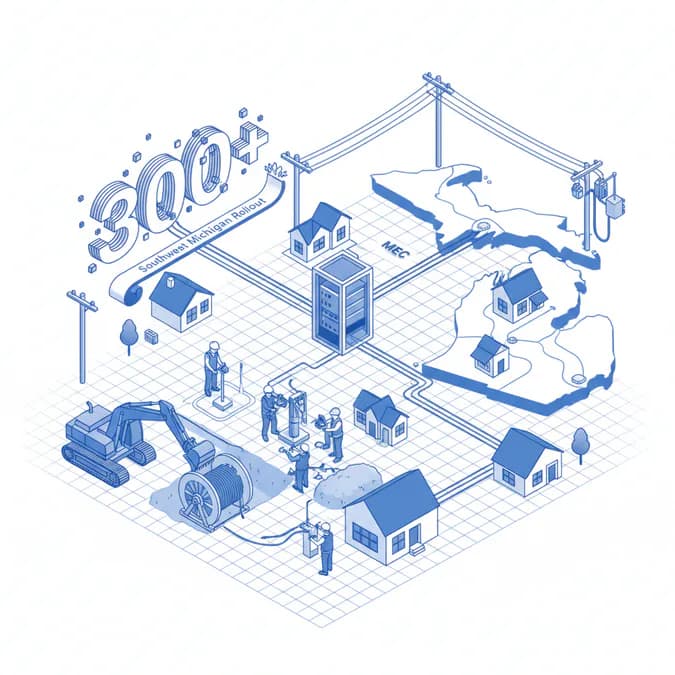
Midwest Energy & Communications (MEC) has launched an ambitious MEC fiber broadband expansion project, beginning construction on over 300 miles of new fiber optic cable in Southwest Michigan. This comprehensive MEC fiber broadband expansion initiative targets five rural communities—Benton Harbor, Coloma, Covert, Hartford, and Schoolcraft—and will bring high-speed internet access to approximately 3,000 previously underserved homes and businesses. [Source: WSJM News]
This MEC fiber broadband expansion represents a significant milestone in the cooperative's ongoing effort to eliminate the rural digital divide. Since launching its fiber broadband initiative in 2015, the customer-owned electric cooperative has connected over 76,000 addresses to high-speed internet, with 30,000 fiber internet customers already online as of early 2025. [Source: Fiber Broadband Association] The current phase, which began February 16, 2026, demonstrates MEC's commitment to systematic rural broadband deployment across multiple counties, addressing connectivity gaps that have persisted for years in these underserved areas.
Project Overview and Scope of MEC Fiber Broadband Expansion
The MEC fiber broadband expansion project encompasses substantial infrastructure development designed to serve rural communities systematically. The initiative will deploy modern fiber optic technology across Southwest Michigan, fundamentally transforming connectivity for residents and businesses in previously underserved regions.
MEC's approach to thi

The five target communities represent diverse rural areas with distinct economic characteristics. Benton Harbor serves as a regional hub with manufacturing heritage, while Coloma, Covert, Hartford, and Schoolcraft represent smaller agricultural and residential communities. Each community faces similar challenges regarding broadband access, making this MEC fiber broadband expansion critical for economic development across the region.
Infrastructure and Service Details
MEC's fiber internet service offers three tiered plans designed to meet different customer needs:
- 100 Mbps Plan: $65 per month with unlimited data
- 1 Gbps Plan: $100 per month with unlimited data
- 5 Gbps Plan: $200 per month with unlimited data
These speeds represent a dramatic improvement for rural residents and businesses that have historically struggled with limited connectivity options. The availability of gigabit-speed internet fundamentally changes what's possible in rural areas, enabling entrepreneurs to launch online businesses, families to access educational resources, and workers to participate in the remote work economy.
The fiber optic infrastructure being deployed through this MEC fiber broadband expansion is modern, scalable technology that will serve these communities for decades. Unlike older copper-based systems, fiber provides symmetrical upload and download speeds, making it suitable for video conferencing, cloud computing, and other bandwidth-intensive applications essential in today's digital economy. This technological advantage positions Southwest Michigan communities to compete effectively in the digital marketplace.
Fiber technology offers significant advantages over traditional broadband infrastructure. Fiber optic cables transmit data using light signals, enabling speeds that copper infrastructure cannot match. The symmetrical nature of fiber connections—where upload and download speeds are equal—proves particularly valuable for remote workers, small business owners, and families engaged in video-based education or entertainment. This fiber broadband expansion technology ensures rural areas gain parity with urban connectivity standards.
Funding and Community Partnerships
The Southwest Michigan MEC fiber broadband expansion is made possible through a combination of funding sources and strategic partnerships. The project receives support from:
- The FCC's Rural Digital Opportunity Fund (RDOF)
- Michigan's ROBIN grant program
- Direct partnerships with local counties including Berrien County, Cass County, and Van Buren County
This multi-source funding approach demonstrates the collaborative effort required to bring broadband infrastructure to rural areas. As MEC leadership stated: "The expansion was made possible thanks to the 2020 Rural Digital Opportunity Fund (RDOF) from the FCC, the State of Michigan's ROBIN grant, and direct partnerships with communities." [Source: Fiber Broadband Association]
The involvement of county governments and state programs underscores the recognition that broadband infrastructure is essential public infrastructure. Federal and state broadband initiatives have been instrumental in funding rural projects, acknowledging that market forces alone have not adequately addressed rural connectivity gaps. The FCC's Rural Digital Opportunity Fund represents a significant federal commitment to rural broadband, allocating billions of dollars to support projects like MEC's expansion.
Michigan's ROBIN (Reconnecting Opportunity for Broadband Investment Now) grant program complements federal funding by providing state-level support for broadband infrastructure projects. This dual-funding approach accelerates deployment timelines and reduces the financial burden on cooperatives and local communities. County partnerships ensure that local priorities and infrastructure considerations inform project planning and execution.
Impact on Rural Communities
For residents and businesses in the targeted areas, this MEC fiber broadband expansion opens new possibilities for economic development and quality of life improvements. High-speed broadband enables:
- Remote work opportunities that were previously impossible in rural areas
- Online education and training programs with reliable video streaming
- Telemedicine services connecting rural patients with specialists
- Digital commerce and e-commerce business opportunities
- Entertainment and streaming services without buffering or data limitations
- Agricultural technology applications for precision farming and farm management
- Small business growth through digital marketing and online sales channels
MEC recognizes the broader significance of this work, stating: "MEC shares in the frustration of this divide and actively seeks to eliminate it." [Source: Team Midwest News] This commitment reflects the cooperative's understanding that broadband access directly impacts community prosperity and resident quality of life.
Improved broadband access typically correlates with increased property values, business development, and population retention in rural areas. Research indicates that communities with reliable high-speed broadband experience measurable economic benefits, including increased business formation rates, higher average household incomes, and improved educational outcomes. For Southwest Michigan communities, this MEC fiber broadband expansion represents an investment in their economic future and competitiveness in the digital economy.
The economic impact extends beyond individual households. Businesses in rural areas with reliable broadband access can compete nationally and internationally, accessing larger markets and specialized services previously unavailable in their regions. Agricultural operations benefit from precision farming technologies, supply chain management systems, and direct-to-consumer marketing opportunities enabled by high-speed internet.
MEC's Broader Expansion Strategy
The Southwest Michigan project is part of MEC's aggressive 2026 expansion strategy. The cooperative plans to reach an additional 50,000 addresses by the end of 2026, representing a substantial acceleration of its broadband deployment efforts. [Source: Moody on the Market] This ambitious target demonstrates MEC's commitment to systematically addressing the rural digital divide across its service territory.
This phased approach allows MEC to manage construction logistics while maintaining service quality for existing customers. The organization has demonstrated consistent progress, with previous announcements indicating plans to bring fiber internet to over 4,000 additional addresses across South Michigan communities. The MEC fiber broadband expansion strategy reflects a long-term vision for comprehensive rural broadband coverage, with multiple projects at various stages of planning and deployment.
MEC's expansion efforts reflect a broader national trend toward rural broadband development. As remote work becomes increasingly common and digital services become essential, communities without reliable broadband face economic disadvantages. Projects like MEC's fiber rollout help level the playing field for rural residents and businesses, ensuring that geographic location no longer determines access to digital opportunity.
The construction timeline will span months, but the long-term benefits for Southwest Michigan are substantial. By systematically expanding fiber infrastructure across rural areas, MEC is addressing one of the most significant barriers to rural economic development and quality of life in the 21st century. The cooperative's experience managing large-scale infrastructure projects positions it well to execute this ambitious expansion while maintaining quality standards.
Timeline and Construction Details
Construction on the MEC fiber broadband expansion began February 16, 2026, with deployment expected to continue throughout the year. The phased approach allows crews to work systematically through each community, minimizing disruption while ensuring thorough infrastructure installation. Residents in targeted areas can expect construction activities including trenching, pole installation, and fiber cable deployment.
MEC coordinates closely with local governments and utility providers to ensure construction schedules accommodate community needs and avoid conflicts with existing infrastructure. The cooperative provides regular updates to affected residents regarding construction timelines and service activation dates. This communication approach helps manage expectations and allows residents to plan for service transitions.
The deployment of 300+ miles of fiber optic cable represents substantial logistical coordination. MEC works with experienced contractors familiar with rural broadband deployment, ensuring quality installation that meets industry standards. The fiber infrastructure installed during this MEC fiber broadband expansion will provide the foundation for service delivery for decades, making installation quality critical to long-term project success.
Technology and Service Quality Standards
MEC's fiber internet service meets rigorous technology standards ensuring reliable, high-speed connectivity. The fiber optic infrastructure deployed through this expansion uses modern equipment and installation practices that exceed industry standards. Network redundancy and backup systems ensure service continuity even during equipment failures or maintenance activities.
Customer service quality represents a priority for MEC, with dedicated support teams available to assist with service issues, technical questions, and account management. The cooperative's customer-owned structure means that users have a voice in service decisions and network investments, distinguishing MEC from commercial internet service providers.
The technology deployed supports future speed increases without requiring infrastructure replacement. As fiber technology advances and customer demand grows, MEC can upgrade service speeds by updating equipment rather than replacing cables. This future-proofing aspect makes fiber infrastructure a superior long-term investment compared to copper-based alternatives. The MEC fiber broadband expansion infrastructure will remain viable and upgradeable for decades.
Economic Development Implications
Broadband infrastructure serves as a foundation for rural economic development. Communities with reliable high-speed internet attract businesses, entrepreneurs, and remote workers seeking rural lifestyles without sacrificing digital connectivity. The MEC fiber broadband expansion positions Southwest Michigan communities to participate in this economic transformation.
Small businesses benefit significantly from broadband access. E-commerce capabilities, digital marketing tools, and cloud-based business applications become viable for rural entrepreneurs. Agricultural businesses gain access to precision farming technologies, market information systems, and supply chain management tools that improve profitability and competitiveness.
Educational institutions benefit from broadband infrastructure, enabling distance learning, research collaboration, and access to digital educational resources. Students in rural areas gain equal access to online learning platforms, virtual classrooms, and educational content previously limited by connectivity constraints. The MEC fiber broadband expansion ensures educational equity across geographic regions.
Key Takeaways
- MEC fiber broadband expansion deploys 300+ miles of fiber optic cable across Southwest Michigan, connecting 3,000 homes and businesses
- The project targets five rural communities: Benton Harbor, Coloma, Covert, Hartford, and Schoolcraft
- Funding combines FCC Rural Digital Opportunity Fund, Michigan ROBIN grants, and county partnerships
- MEC has connected over 76,000 addresses since 2015, with 30,000 active fiber customers as of early 2025
- Service plans range from 100 Mbps ($65/month) to 5 Gbps ($200/month) with unlimited data
- The expansion supports remote work, education, telemedicine, and business development in rural areas
- MEC plans to reach 50,000 additional addresses by end of 2026
- Fiber technology provides symmetrical speeds and future-proof infrastructure for decades of service
Frequently Asked Questions
What is the MEC fiber broadband expansion project?
The MEC fiber broadband expansion is a comprehensive infrastructure initiative deploying over 300 miles of fiber optic cable across Southwest Michigan. The project brings high-speed internet to approximately 3,000 homes and businesses in five rural communities, beginning construction in February 2026.
Which communities are included in the MEC fiber broadband expansion?
The expansion targets Benton Harbor, Coloma, Covert, Hartford, and Schoolcraft in Southwest Michigan. These communities represent diverse rural areas with limited previous broadband access.
How much does MEC fiber internet service cost?
MEC offers three service tiers: 100 Mbps for $65/month, 1 Gbps for $100/month, and 5 Gbps for $200/month. All plans include unlimited data with no overage charges.
How is the MEC fiber broadband expansion funded?
The project receives funding from the FCC's Rural Digital Opportunity Fund (RDOF), Michigan's ROBIN grant program, and direct partnerships with Berrien County, Cass County, and Van Buren County.
When will service be available in my area?
Construction began February 16, 2026, with deployment continuing throughout the year. Residents can check MEC's website or contact the cooperative directly for specific timelines for their communities.
Why is fiber better than traditional broadband?
Fiber optic technology provides faster speeds, symmetrical upload and download capabilities, and greater reliability than copper-based systems. Fiber infrastructure also supports future speed increases without replacement.
How many customers has MEC connected to fiber internet?
As of early 2025, MEC has connected over 76,000 addresses to fiber infrastructure, with 30,000 active fiber internet customers. The cooperative plans to reach 50,000 additional addresses by end of 2026.
What economic benefits does broadband access provide to rural communities?
Broadband enables remote work opportunities, supports small business growth, improves educational access, enables telemedicine services, and increases property values. Communities with reliable broadband experience measurable economic development benefits.
How long will the MEC fiber broadband expansion take?
Construction will span multiple months throughout 2026, with phased deployment across the five target communities. Specific timelines vary by location based on infrastructure complexity and construction logistics.