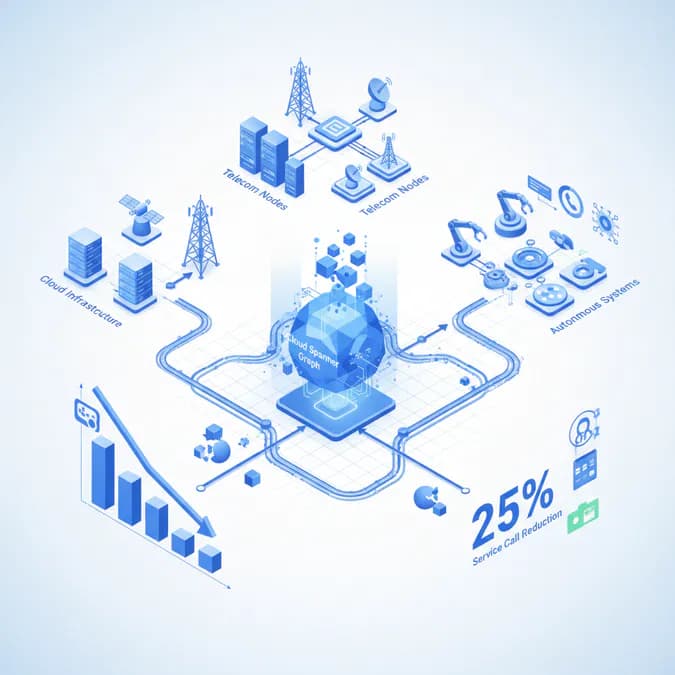
The telecommunications industry faces a critical challenge: data fragmentation. Across Operations Support Systems (OSS) and Business Support Systems (BSS), telecom operators manage vast amounts of siloed data that prevents them from leveraging artificial intelligence for autonomous network operations. At Mobile World Congress 2026, Google Cloud introduced Cloud Spanner Graph, a multi-model database designed to unify this fragmented data and enable real-time digital twins of network infrastructure. Cloud Spanner Graph telecom solutions represent a fundamental shift in how operators can achieve autonomous network operations and reduce operational costs.
This innovation addresses a fundamental problem in modern telecom operations. As networks become increasingly complex with 5G deployments and beyond, the data generated across different systems creates what industry experts call a 'data swamp'—disconnected information that hinders AI adoption and prevents networks from achieving true autonomy. Google Cloud's solution combines relational, graph, vector, and text data into a single platform, enabling telecom operators to create live network maps and deploy AI agents that can predict failures, diagnose problems, and optimize operations automatically. Research indicates that operators implementing Cloud Spanner Graph telecom platforms experience measurable improvements in network reliability and operational efficiency.
The Data Fragmentation Crisis in Telecommunications
Telecom operators today manage complex networks that generate enormous volumes of data. This data flows through multiple systems—OSS for network operations, BSS for billing and customer management, and countless other specialized platforms. The problem is that these systems rarely communicate effectively, creating isolated data silos that prevent operators from gaining a compl

This fragmentation has serious consequences. When data remains siloed, operators cannot leverage artificial intelligence effectively. They cannot predict network failures before they occur. They cannot automatically diagnose and repair issues. Instead, they rely on reactive approaches, responding to problems after customers experience service degradation. This approach is expensive, inefficient, and increasingly unsustainable as networks become more complex.
The TM Forum, an industry standards organization, has defined autonomy levels for networks, ranging from Level 1 (fully manual) to Level 5 (fully autonomous). Most telecom operators today operate at Levels 1-3, where human intervention is required for most operational decisions. Reaching Levels 4-5, where networks self-diagnose and repair issues, requires solving the data fragmentation problem first. Industry experts note that this transition demands more than software adoption—it requires a complete operational model transformation. As noted in industry analysis, "This isn't just about buying software. It's about adopting a new operational model."
Cloud Spanner Graph Telecom: A Digital Twin Solution
Google Cloud's response to this challenge is Cloud Spanner Graph, a multi-model database that represents a fundamental shift in how telecom operators can manage network data. Rather than forcing data into a single format or maintaining separate systems, Cloud Spanner Graph accepts relational data, graph data, vector embeddings, and text data—all within a unified platform. Cloud Spanner Graph telecom implementations enable operators to consolidate their data infrastructure while maintaining real-time performance.
The key innovation is the concept of a digital twin. Cloud Spanner Graph creates a live, temporal representation of the entire network—a digital twin that mirrors the physical network in real-time. This digital twin serves as a single source of truth for all network-related information, from infrastructure topology to service performance metrics to customer relationships. By centralizing network data, Cloud Spanner Graph telecom solutions eliminate the silos that have historically prevented effective AI implementation.
What makes this approach powerful is that it enables AI agents to operate with complete context. Rather than working with fragmented data from isolated systems, AI algorithms can access a unified view of the network. This context is essential for advanced AI techniques like Graph Neural Networks (GNNs), which can identify patterns and predict failures by analyzing relationships between network components. Research demonstrates that Graph Neural Networks applied to unified network data can identify anomalies with significantly higher accuracy than traditional approaches.
How Cloud Spanner Graph Telecom Enables Autonomous Operations
Google Cloud has developed a comprehensive framework for autonomous network operations that leverages Cloud Spanner Graph as its foundation. This framework, which targets TM Forum Levels 4-5 autonomy, integrates three key Google Cloud services: Spanner for data unification, BigQuery for analytics, and Vertex AI for machine learning. Cloud Spanner Graph telecom architectures built on this framework enable operators to transition from reactive to predictive network management.
The process begins with data unification. Google Cloud partners with companies like DigitalRoute to create reusable data pipelines that standardize data from multiple sources. These pipelines run on Google Kubernetes Engine (GKE) and feed data into both BigQuery for analytics and Cloud Spanner Graph for real-time operations. This approach ensures that data is consistent, current, and accessible to AI systems. Industry partners report that standardized data pipelines reduce implementation time by 40-50% compared to custom solutions.
Once data is unified in Cloud Spanner Graph, AI agents can perform several critical functions:
- Detect anomalies in network performance by analyzing historical patterns and real-time metrics
- Predict failures before they occur by identifying warning signs in network data
- Perform root-cause analysis by tracing relationships between network components
- Recommend or automatically execute remediation actions to restore service
Google Cloud emphasizes that "data readiness is the bedrock of true autonomy." Without properly unified and structured data, even the most sophisticated AI algorithms cannot function effectively. Cloud Spanner Graph telecom platforms address this requirement by providing a database where data is not just stored, but organized in ways that enable AI reasoning and autonomous decision-making.
Real-World Results from Leading Operators
Google Cloud's approach is not theoretical. Several major telecom operators have already implemented Cloud Spanner Graph and achieved measurable results demonstrating the value of Cloud Spanner Graph telecom solutions.
Bell Canada's Predictive Success
Bell Canada provides a concrete example of the impact. Using historical data and predictive algorithms built on Cloud Spanner Graph, Bell Canada achieved a 25% reduction in service calls related to RAN (Radio Access Network) anomalies. This reduction represents significant cost savings and improved customer experience. Rather than customers calling to report network problems, Bell Canada's systems now identify and resolve issues proactively. The operator's success with Cloud Spanner Graph telecom implementation demonstrates how data unification directly translates to operational improvements and customer satisfaction gains.
Fastweb and Vodafone's Data Transformation
Fastweb and Vodafone have taken a different but equally valuable approach. They use Cloud Spanner Graph for data lineage visualization and customer relationship analysis. By understanding how data flows through their systems and how different data elements relate to customer experiences, they have fundamentally reimagined their data workflows. Industry sources note that these operators have transformed not just their technical infrastructure, but their entire organizational approach to data management and decision-making through Cloud Spanner Graph telecom implementations.
These results demonstrate that the benefits of Cloud Spanner Graph extend beyond technical metrics. The technology enables organizational transformation, changing how teams work and how decisions are made. Operators implementing Cloud Spanner Graph telecom solutions report improved collaboration between network operations, business intelligence, and customer service teams.
Strategic Partnerships Driving Implementation
Google Cloud recognizes that solving telecom data fragmentation requires partnerships with companies that understand the industry deeply. Several strategic partnerships announced at MWC26 illustrate this ecosystem approach to Cloud Spanner Graph telecom deployment.
DigitalRoute Partnership: Data Pipeline Excellence
DigitalRoute partnership focuses on data pipelines and integration. DigitalRoute specializes in telecom data integration, and their partnership with Google Cloud creates reusable pipelines that can be deployed across different operators. These pipelines standardize data from diverse sources, making it ready for AI-driven anomaly detection and predictive maintenance. This approach accelerates implementation by providing proven, industry-specific solutions rather than requiring each operator to build pipelines from scratch. Cloud Spanner Graph telecom implementations leveraging DigitalRoute's expertise reduce time-to-value significantly.
NetAI Partnership: AIOps in Action
NetAI partnership targets AIOps (AI-driven operations) and autonomous network management. Google Cloud and NetAI are conducting pilots with major European operators, using GraphML-based digital twins to resolve network incidents with machine-speed accuracy. This pilot demonstrates how Graph Neural Networks can be applied to real-world telecom operations, identifying and resolving problems faster than traditional approaches. Cloud Spanner Graph telecom solutions combined with NetAI's AI expertise enable operators to achieve higher levels of network autonomy.
Nokia Partnership: Network as Code
Nokia partnership introduces 'Network as Code' concepts to Cloud Spanner Graph telecom implementations. This collaboration turns network configuration and operations into code that AI agents can understand and execute. Rather than operators manually configuring networks through traditional interfaces, they can describe desired network behavior in natural language, and AI agents translate these descriptions into network operations. This approach makes network management more intuitive and enables faster, more accurate implementation of operational changes. Industry experts note that Network as Code approaches reduce configuration errors and accelerate deployment cycles.
These partnerships demonstrate that Google Cloud is not attempting to solve telecom challenges alone. Instead, the company is building an ecosystem of partners that collectively address different aspects of the data fragmentation problem. Cloud Spanner Graph telecom success depends on this collaborative approach combining database technology, data integration expertise, AI capabilities, and network operations knowledge.
The Path to Network Autonomy
The announcements at MWC26 represent a significant step toward truly autonomous telecom networks. However, the journey is just beginning. Reaching TM Forum Level 5 autonomy—where networks operate almost entirely without human intervention—will require continued evolution of both technology and operational practices. Cloud Spanner Graph telecom platforms provide the foundation, but operators must commit to a multi-phase transformation journey.
Foundation: Data Readiness
The foundation is data readiness. Operators must invest in unifying their data across OSS, BSS, and other systems. Cloud Spanner Graph provides the platform for this unification, but implementation requires commitment and planning. Operators must identify which data sources are most critical, establish data quality standards, and create pipelines that continuously feed current data into the unified platform. Research indicates that operators spending 6-12 months on data preparation see significantly better outcomes from Cloud Spanner Graph telecom deployments.
Next Layer: AI Capability Development
The next layer is AI capability development. Operators must build or acquire AI models that can operate effectively within their specific network environments. This requires domain expertise—understanding not just machine learning, but telecom operations. Partnerships with companies like NetAI help operators accelerate this development. Cloud Spanner Graph telecom implementations combined with specialized AI expertise enable operators to deploy production-ready autonomous systems faster.
Final Layer: Organizational Change
The final layer is organizational change. Industry experts note that adopting autonomous network operations is not just about technology—it's about adopting a new operational model. This requires training teams, changing decision-making processes, and building confidence in AI-driven operations. Operators that successfully navigate this organizational transformation will gain significant competitive advantages. Cloud Spanner Graph telecom implementations that include change management and training programs show higher adoption rates and faster ROI.
Google Cloud's strategy addresses all three layers. The technology (Cloud Spanner Graph) provides the data foundation. The partnerships provide AI expertise and industry-specific solutions. And the framework—targeting specific TM Forum autonomy levels—provides a roadmap for organizational change. Cloud Spanner Graph telecom success requires attention to all three dimensions of transformation.
Frequently Asked Questions About Cloud Spanner Graph Telecom
What is Cloud Spanner Graph and how does it solve telecom data fragmentation?
Cloud Spanner Graph is a multi-model database that unifies relational, graph, vector, and text data into a single platform. Cloud Spanner Graph telecom solutions solve data fragmentation by creating a single source of truth for all network data, eliminating silos that have historically prevented effective AI implementation in telecom operations.
How much can operators reduce service calls with Cloud Spanner Graph telecom?
Bell Canada achieved a 25% reduction in service calls related to RAN anomalies using Cloud Spanner Graph. Results vary by operator and implementation approach, but predictive capabilities enabled by Cloud Spanner Graph telecom platforms consistently reduce reactive service calls and improve customer experience.
What is a digital twin in the context of Cloud Spanner Graph telecom?
A digital twin is a live, real-time representation of the physical network stored in Cloud Spanner Graph. Cloud Spanner Graph telecom digital twins mirror network infrastructure, service performance, and customer relationships, enabling AI agents to analyze and optimize operations based on complete network context.
Which telecom operators are currently using Cloud Spanner Graph?
Bell Canada, Fastweb, Vodafone, and MasOrange are among the major operators implementing Cloud Spanner Graph. These operators are demonstrating the value of Cloud Spanner Graph telecom solutions through measurable improvements in network operations and customer satisfaction.
How long does it take to implement Cloud Spanner Graph telecom solutions?
Implementation timelines vary based on operator size, data complexity, and organizational readiness. Operators typically spend 6-12 months on data preparation and initial Cloud Spanner Graph telecom deployment, with ongoing optimization and AI capability development continuing over subsequent years.
What partnerships support Cloud Spanner Graph telecom implementation?
Key partners include DigitalRoute (data integration), NetAI (AI operations), and Nokia (Network as Code). These partners provide specialized expertise that accelerates Cloud Spanner Graph telecom deployment and enables operators to achieve autonomous network operations faster.
Key Takeaways
Data fragmentation has been a persistent challenge in telecommunications, preventing operators from fully leveraging artificial intelligence for network operations. Google Cloud's Cloud Spanner Graph, announced at MWC26, represents a significant step toward solving this problem. By unifying relational, graph, vector, and text data into a single platform, Cloud Spanner Graph telecom solutions enable operators to create digital twins of their networks and deploy AI agents that can predict failures, diagnose problems, and optimize operations automatically.
The early results are promising. Bell Canada has achieved a 25% reduction in service calls through predictive algorithms powered by Cloud Spanner Graph telecom technology. Fastweb and Vodafone have fundamentally transformed how they manage data and operations. And strategic partnerships with DigitalRoute, NetAI, and Nokia are accelerating implementation across the industry.
For telecom operators seeking to bridge their 5G investments to actual revenue growth, data unification through platforms like Cloud Spanner Graph is no longer optional—it's essential. The operators that move quickly to unify their data and implement Cloud Spanner Graph telecom solutions will gain significant competitive advantages in an increasingly complex network environment. Success requires commitment to data preparation, AI capability development, and organizational transformation, but the results—demonstrated by early adopters—justify the investment.
Sources
- Automated Pipeline
- Autonomous networks at MWC 2026 | Google Cloud Blog
- Google Cloud opens up its network automation playbook for telcos
- Google Cloud, DigitalRoute Team Up to Tackle Telco Data Challenges
- How Fastweb + Vodafone reimagined data workflows with Spanner & BigQuery
- Source: techzine.eu
- Source: fiercewireless.com
- Source: omdia.tech.informa.com
- Source: docs.cloud.google.com