Table of Contents

- Introduction to 6G Technology
- Integrated Sensing and Communications (ISAC)
- Applications of ISAC
- Impact on Enterprise Services
- Future of Telecommunications with 6G Technology
- Key Takeaways
- FAQ about 6G Technology
Introduction to 6G Technology
6G technology represents the sixth generation of wireless cellular networks, building upon the foundations laid by 5G. Research into 6G began around 2018, with significant milestones expected by 2026, when practical specifications will likely be discussed. This revolutionary technology aims to deliver speeds exceeding 100 Gbps, with latency reduced to just 1 millisecond, making it ten tim

Integrated Sensing and Communications (ISAC)
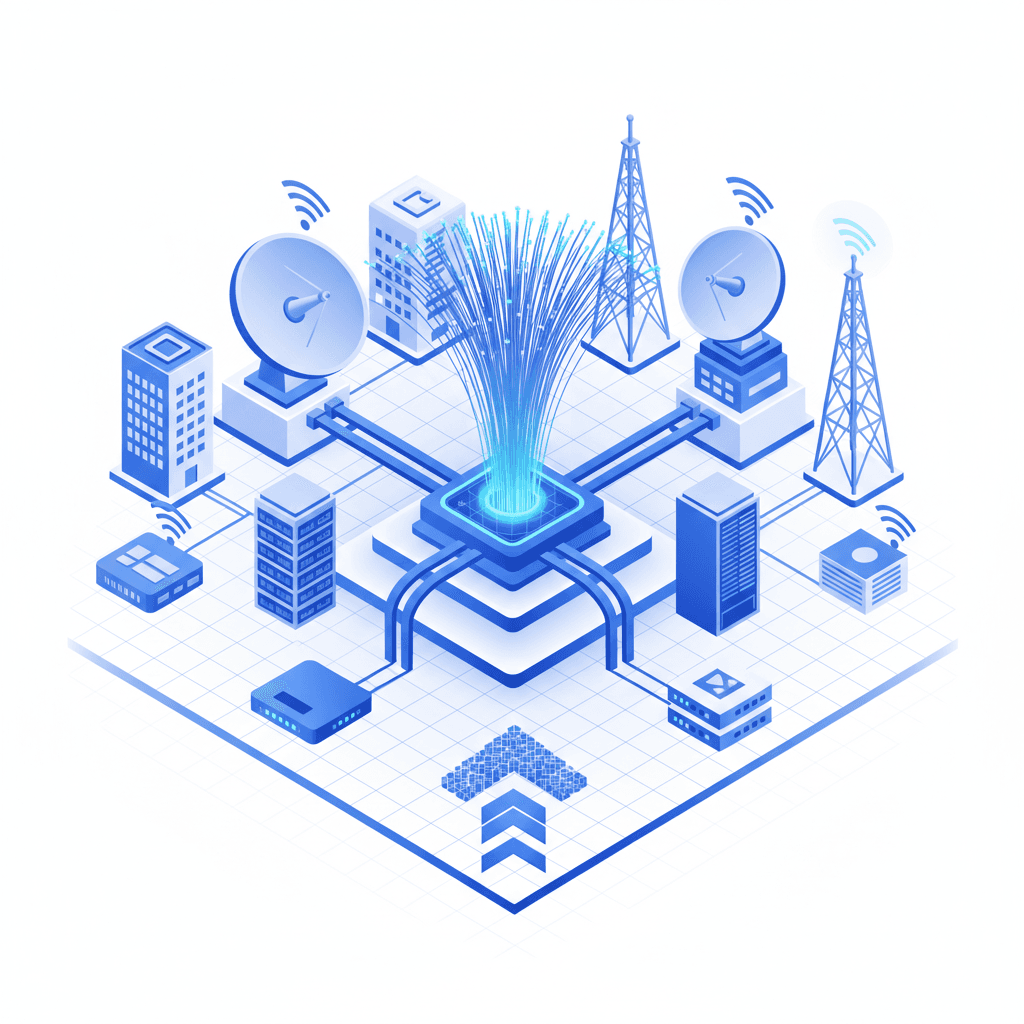
A key feature of 6G technology is Integrated Sensing and Communications (ISAC), which allows networks to perform dual functions: data transmission and environmental sensing. This means that telecom networks will not only transmit data but also detect movement and map surroundings using the same infrastructure. This multi-functional approach is set to revolutionize how we interact with technology and our environment, enabling smarter cities and more efficient systems.
Applications of ISAC
- Autonomous mobility
- Wide-area mixed reality
- Massive digital twinning
- Smart cities
Leading companies like Ericsson, Samsung, and Huawei are actively prototyping ISAC systems, aiming to position 6G technology as a versatile infrastructure beyond mere connectivity. According to a report by Forbes, 6G technology is expected to integrate AI and machine learning, enhancing its capabilities.
Impact on Enterprise Services
The advent of 6G technology and ISAC will significantly impact enterprise services. With the ability to sense environments, businesses can leverage real-time data for improved decision-making and operational efficiency. For instance, industries can utilize 6G technology for:
- Enhanced logistics and supply chain management through real-time tracking.
- Smart manufacturing with automated systems that adapt to changing conditions.
- Advanced healthcare solutions, including remote patient monitoring and telemedicine.
As William Webb, an IEEE Fellow, stated, "I expect 6G technology to be more aligned with the requirements of operators. It will deliver efficiencies, lower operational costs, lower power consumption, and better integrate with other networks" [Source]. The integration of 6G technology will not only enhance business operations but also foster innovation across various sectors.
Future of Telecommunications with 6G Technology
The future of telecommunications is poised for a dramatic shift with the implementation of 6G technology. By 2026, it is expected that 40% of networks will integrate AI and machine learning capabilities, enhancing their functionality and efficiency [Source]. The performance targets for 6G technology include:
- 1 millisecond latency
- 100 bps/Hz spectral efficiency
- Support for 100 million devices per km²
As the industry moves towards 2030, the integration of satellite and terrestrial networks will further enhance global connectivity, making 6G technology a cornerstone of future technological advancements. This evolution is expected to create new opportunities for businesses and consumers alike.
Key Takeaways
- 6G technology will enable ultra-fast communication and environmental sensing.
- It will significantly impact various sectors, including healthcare and smart cities.
- Major telecommunications companies are actively developing ISAC systems.
- The integration of AI and machine learning will enhance the capabilities of 6G technology.
FAQ about 6G Technology
Q: What is 6G technology?
A: 6G technology is the sixth generation of wireless networks, expected to deliver speeds exceeding 100 Gbps and ultra-low latency.
Q: When is 6G expected to be available?
A: Significant milestones for 6G technology are expected by 2026, with practical specifications likely to be discussed.
Q: How will 6G impact businesses?
A: 6G technology will enhance operational efficiency and decision-making through real-time data and environmental sensing capabilities.
In conclusion, 6G technology is set to redefine telecommunications by merging connectivity with environmental sensing capabilities. This evolution will not only enhance user experiences but also pave the way for innovative enterprise solutions, ultimately transforming how we live and work. The potential of 6G technology is immense, and its impact will be felt across all sectors of society.